The SchoolWorks Lab

Discovering How Learning Happens

The SchoolWorks Lab is an educational research and innovation organization investigating how learning develops, how educators recognize it, and how better evidence can help every learner grow, succeed, and thrive.

We begin with a simple observation.

Teachers see learning happen every day.

They see it when a student suddenly makes a connection. When an explanation becomes clearer. When a misconception changes. When a learner recognizes a pattern, revises an idea, solves a problem differently, or applies something learned in a new situation.

Yet much of what our educational system calls evidence captures only a small part of that development.

The SchoolWorks Lab exists to investigate what we may be missing.

Our central question is:

How do we know when learning is happening?

Our Mission

Research. Evidence. Innovation. Impact.

Our mission is to advance educational research that uncovers how learning happens, generates evidence that matters, and supports teachers in helping every learner grow, succeed, and thrive.

We bring together educational research, classroom practice, technology, and professional judgment to investigate better ways of understanding learning.

We believe better evidence can lead to better questions — and better questions can lead to better teaching.

Why SchoolWorks Exists

Education has become extraordinarily good at producing information about students: Test scores. grades, benchmarks, assignments, attendance records, learning-platform data, teacher observations, student work. Yet more information does not necessarily produce greater understanding.

A student can have an extensive educational record while the most important question remains surprisingly difficult to answer: How is this learner’s understanding actually developing?

SchoolWorks was created to investigate that gap. We are interested not simply in measuring what students can demonstrate at a particular moment, but in understanding the evidence of learning across time.

What We Believe

Our work begins with several propositions that we are willing to investigate, test, refine—and change when the evidence requires it.

Intelligence develops

Human intelligence is not adequately understood as a single fixed quantity. Learning, experience, relationships, reflection, and opportunity contribute to development.

Learning leaves evidence

Changes in understanding can become visible through what learners say, do, create, explain, question, revise, connect, and transfer.

Evidence becomes more meaningful across time

A single assessment can provide useful information. A sequence of evidence may reveal development that an individual snapshot cannot.

Teachers are essential interpreters of evidence

Technology can help organize information and reveal possible patterns. It cannot replace the contextual knowledge, relationships, expertise, and professional judgment educators bring to understanding learners.

Students should participate in understanding their own learning

Students can become contributors to the evidence of their development rather than simply recipients of scores and judgments.

Our ideas must be tested. We do not assume these propositions are true simply because we find them compelling. That is why SchoolWorks conducts research.

How We Work

From Ideas to Evidence

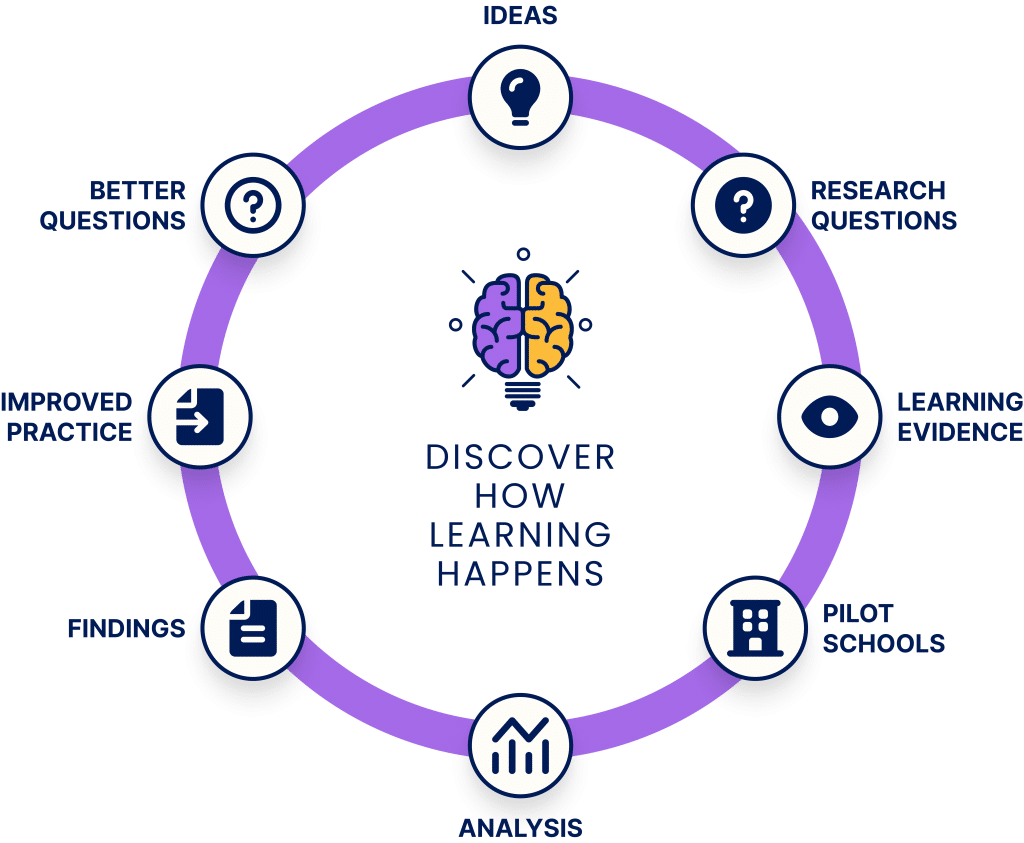
SchoolWorks connects theory, research, classroom practice, and technology through a continuous cycle:

Progression graphic: Ideas → Research Questions → Learning Evidence → Pilot Schools → Analysis → Findings → Improved Practice → Better Questions

The process then begins again. We are not trying to prove what we already believe. We are trying to discover what the evidence supports.

Our Research

Our current research program examines five interconnected areas:

Teacher Workload 
Can better-organized evidence reduce rather than increase the burden on teachers?

Learning Patterns 
Can longitudinal evidence reveal changes in understanding that conventional assessments may miss?

Professional Judgment 
What evidence helps teachers make stronger and more trustworthy instructional decisions?

Student Portfolios 
Can students meaningfully contribute to documenting and understanding their own learning?

Interoperability Can learning evidence become more useful by connecting information across the tools schools already use?

Our Living Laboratories

Research Where Learning Happens

SchoolWorks conducts research in partnership with educators and schools.

Our pilot sites allow us to investigate these questions in authentic educational environments rather than only in theory: Different ages, different subjects, different teaching approaches, different technologies, different communities and cultures.

The variation matters because an idea about learning should not be considered robust simply because it works in one classroom or one school.

Our schools are not demonstration sites. They are research partners.

Teachers and students help us discover what works, what does not, what needs to change, and what questions we should ask next.

Pathfinder

Turning Ideas Into Something We Can Test

To investigate these questions, SchoolWorks is developing and testing Pathfinder.

Pathfinder is a research platform designed to organize learning evidence across time, make patterns in developing understanding more visible, and support teacher professional judgment. It gives us a practical instrument for testing questions that otherwise remain theoretical.

  • Can evidence be captured without burdening teachers?
  • Can disconnected evidence become a coherent longitudinal record?
  • Can meaningful patterns become more visible?
  • Can students contribute to that record?
  • Can technology support professional judgment without replacing it?


Pathfinder supports teacher judgment. It does not replace it.

Our Story

Four Decades of Questions About Learning

The SchoolWorks Lab did not begin with Pathfinder. It grew from decades of work in classrooms, schools, districts, educational research, assessment, school improvement, and efforts to understand why some students thrive while others remain poorly served by conventional systems.

Again and again, that work returned to a common problem:

We often have more information about students than we have understanding of their learning.

The development of SchoolWorks represents an effort to bring those accumulated questions together into a focused research agenda. Rather than beginning with another program, assessment, or technology, we returned to the underlying questions:

  • What is intelligence?
  • How does learning occur?
  • How can we recognize learning while it is happening?
  • How can educators increase the probability that meaningful learning will occur?
  • How do we know that the learning mattered?


Those questions now guide our work.

Our Founder

Robert A. Southworth, Jr., Ed.D.
Founder & President

Robert A. Southworth, Jr. is an educator, researcher, school leader, and educational innovator whose career has focused on improving learning opportunities for students and helping educators make better use of evidence.

Across more than four decades in education, his work has included teaching and school leadership, educational research, school improvement, assessment, program development, and the design and implementation of new approaches to teaching and learning.

SchoolWorks brings together questions that have emerged throughout that career — particularly the relationship among learning, evidence, assessment, professional judgment, and educational opportunity.

The Lab represents a return to a deceptively simple question that has followed that work for decades: How do we really know when a student has learned?

Our Team

Research Requires Different Ways of Thinking

The SchoolWorks Lab brings together people with experience in:

Educational Research 
Learning science, assessment, evidence, and research design.

Teaching & Learning 
Understanding what research questions look like in actual classrooms.

Technology & Design 
Creating tools capable of organizing complex evidence while remaining useful to educators.

Implementation 
Working alongside schools to understand what is feasible in practice.

International Collaboration 
Examining how assumptions about learning and evidence change across educational and cultural contexts.

Robert A. Southworth, Jr., Ed.D.
Founder & President

Jenny Lynn Weitz, BFA
Tech Implementation & Branding Consultant

Scott Cartwright, MFA
Tech Lead Consultant

Bharti Sharma, Ed.M.
Educational Research Associate

Governance & Stewardship

The SchoolWorks Lab is governed by a Board of Directors committed to the organization’s educational and charitable mission.

The Board provides oversight of the Lab’s research, organizational development, financial stewardship, partnerships, and long-term direction.

As SchoolWorks grows, that stewardship is especially important. Our responsibility is not simply to develop promising ideas. It is to pursue them with intellectual independence, responsible governance, financial transparency, and fidelity to our mission.

Our Commitment

We are at the beginning of an ambitious research program. We will undoubtedly discover things we did not expect. Some ideas will become stronger. Others will change. Some may prove wrong.

We believe that willingness is essential.

Ideas should be identified as ideas.
Evidence should be identified as evidence.
Findings should be earned.

And throughout the work, one principle remains constant: Every learner deserves to be understood as more than a score.

Join the Work

SchoolWorks welcomes collaboration with educators, researchers, schools, universities, foundations, philanthropists, and organizations interested in advancing our understanding of learning.

There are many ways to participate:

  • Become a Research Partner
  • Support the Research
  • Collaborate With SchoolWorks
  • Join a Pilot
  • Explore Our Publications
  • Contact Us


Because answering a question as consequential as—How do we know when learning is happening?—will require many people, many perspectives, and a willingness to follow the evidence wherever it leads.