Research
Investigating How Learning Happens
We study how learning develops, how teachers recognize it, and how better evidence can support better decisions for students.

We study how learning develops, how teachers recognize it, and how better evidence can support better decisions for students.
Our work brings together learning science, assessment, emerging technology, and the professional judgment of teachers. We don’t start with a new test or a new tool. We start with questions:

“Can better-organized evidence reduce the time teachers spend on paperwork?”
Teachers already collect, interpret, and report enormous amounts of information about students. The problem may not be a lack of data. The problem may be that evidence is fragmented across assignments, assessments, observations, learning platforms, spreadsheets, and reporting systems.
We are investigating whether evidence can be captured and organized as part of normal teaching and learning — and whether students themselves can contribute meaningfully to that process.
The goal is not to give teachers another system to maintain. The question is whether better evidence systems can give teachers time back.
“Can longitudinal evidence reveal changes that conventional assessments miss?”
Most assessments examine performance at a particular moment. Learning develops across many moments.
SchoolWorks is investigating whether evidence collected over time can reveal patterns in developing understanding that may be difficult to see in individual scores or assignments.
We are particularly interested in evidence of changes such as: pattern recognition • connection • reorganization • explanation • revision • transfer • reflection
Rather than assuming these are definitive measures of learning, we are studying whether — and under what conditions — they provide useful evidence of developing understanding.
Can a sequence of evidence tell us something a snapshot cannot?
“What evidence helps teachers make stronger decisions?”
Teachers make hundreds of judgments every day:
These decisions involve much more than data. They involve experience, context, evidence, interpretation, and professional judgment.
SchoolWorks is investigating how multiple sources of educational evidence can support teachers in making more transparent, trustworthy, and useful inferences about student learning.
The purpose of evidence is not to replace professional judgment. It is to strengthen it.
“Can students meaningfully contribute to the evidence of their own learning?”
Students are not merely subjects of assessment. They can also become participants in understanding their own learning.
We are investigating how longitudinal student portfolios might allow learners to identify significant work, document changes in their thinking, reflect on their development, and contribute evidence to conversations with teachers.
This raises important questions:
“Can learning intelligence work across the tools teachers already use?”
Schools already have technology. Teachers use learning management systems, assessment platforms, curriculum tools, student information systems, digital portfolios, spreadsheets, and countless other applications.
Our research does not assume that educators need another isolated platform. Instead, we are investigating whether evidence from existing systems can be connected in ways that create a more coherent longitudinal picture of learning.
This makes interoperability more than a technical question:
Can the evidence schools already possess become more useful when it can be understood together?
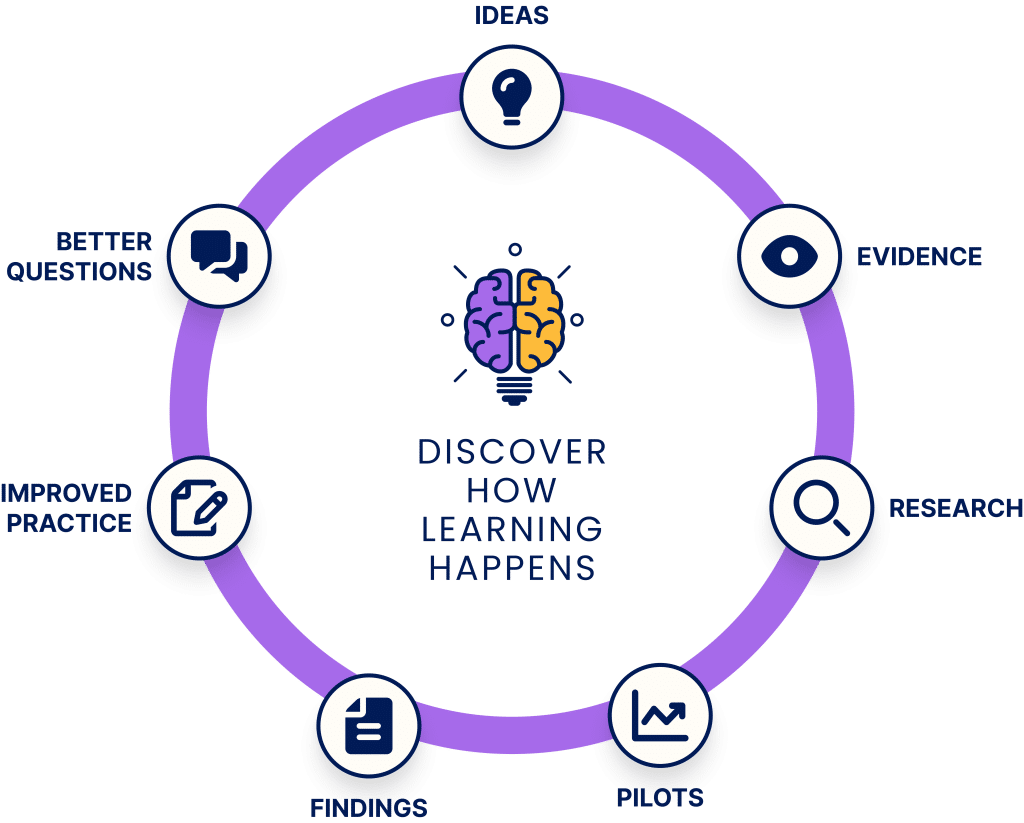
SchoolWorks uses an iterative model of educational research.
We begin with a question. We develop a hypothesis or conceptual model. We identify the evidence needed to investigate it. We work with educators to study the question in authentic learning environments. We examine what the evidence suggests. And then we revise the question, the model, or the research instrument.
Research does not sit outside practice. Practice helps generate the research.


Our pilot schools allow us to investigate these questions where learning actually occurs: in classrooms.
Working with educators and students allows us to examine whether our ideas remain useful when confronted with the complexity of real teaching.
Different schools also provide different contexts in which to test our assumptions:
The purpose of these pilots is not simply to demonstrate Pathfinder. The pilots are part of the research itself. They allow evidence from practice to challenge, refine, and improve our ideas.
Pathfinder occupies a particular place within the SchoolWorks research program. It is not the theory. It is not the research itself. And it is not intended to determine what a student understands.
Pathfinder is the research instrument through which we can test important parts of our hypothesis. Building Pathfinder gives us a practical way to investigate these questions.
SchoolWorks is interested in promising ideas. But promising ideas are not enough. We want to know what the evidence actually supports.
That means distinguishing among:
Our theories and hypotheses.
Questions currently being studied.
Patterns emerging from pilot work.
Findings that have survived systematic examination.
We should be willing to discover that some of our ideas are wrong. That is not a failure of the research. That is the purpose of the research.
Behind these individual studies is a larger question. Education has become increasingly sophisticated at producing data. But we believe there is still important work to be done in understanding how different forms of educational evidence can support trustworthy conclusions about developing learning. This includes questions of:
Does the evidence actually support the conclusion being made?
Would similar evidence lead to reasonably consistent interpretations?
What does the evidence mean within the circumstances in which learning occurred?
What changes when evidence is examined across time?
How should human expertise contribute to interpretation?
Does the evidence help someone make a better educational decision?
Together, these questions point toward an emerging area of inquiry we describe as the Science of Educational Evidence.
Our objective is not simply to produce research about schools. It is to conduct research that can ultimately become useful to schools. The cycle therefore continues, and then it begins again.
Our research is underway. As evidence emerges from our pilot schools and research partnerships, we will publish what we are learning — including findings that support our hypotheses, findings that complicate them, and findings that cause us to change direction.
Because discovering how learning happens requires more than proving what we already believe. It requires following the evidence wherever it leads.